Tag Archives: SA

Walled Gardens & Redirection in 4G/5G (RedirectInformation)

PFCP includes a “Redirect Information” IE, which if set, allows you to change the forwarding action in PFCP to Redirect traffic.

We use this for walled garden redirects, when the OCS reports credit exhausted to the PGW-C, the PGW-C can tell the UPF (PGW-U) that all the traffic from a given subscriber should be redirected to a captive portal / walled garden, like a “Topup Now Page” you’d be used to seeing on Airport WiFi.
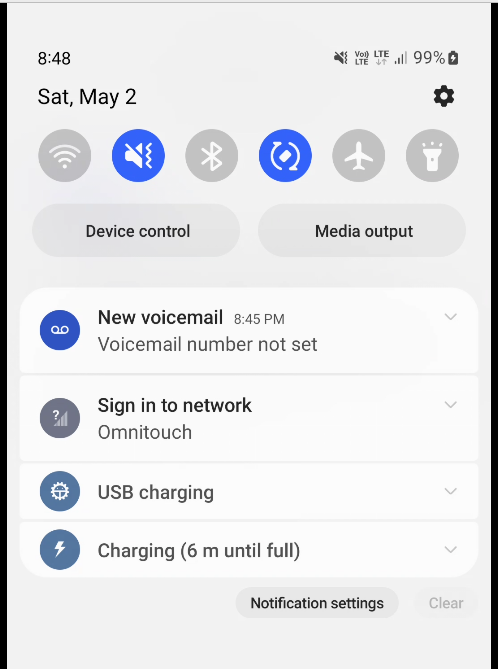
“Sign in to network” prompt presented on Cellular

Here’s what the spec says:

8.37. Redirect-Server AVP The Redirect-Server AVP (AVP Code 434) is of type Grouped and contains the address information of the redirect server (e.g., HTTP redirect server, SIP Server) with which the end user is to be connected when the account cannot cover the service cost. It MUST be present when the Final-Unit-Action AVP is set to REDIRECT. It is defined as follows (per the grouped-avp-def of RFC 3588 [DIAMBASE]): Redirect-Server ::= < AVP Header: 434 > { Redirect-Address-Type } { Redirect-Server-Address }

So how does this work in practice?

Once upon a time, you’d just intercept all HTTP request and serve your own content, but it’s not 2005 on Starbucks WiFi anymore, and SSL is everywhere.

Luckily this is a (mostly) solved problem, Apple has “Captive Network Assistant” that probes http://captive.apple.com/hotspot-detect.html and checks for a specific response, Google’s Android has http://connectivitycheck.gstatic.com/generate_204 and does the same thing.

There is a draft RFC to do this better, but it’s not widely adopted.

But before I can tell you what we do, I’ll show you what we’re not doing before we do the doing so you can see what the do does by looking at what happens when we don’t – Clear?

Before we send any Session Modification Request with redirect I can do a DNS lookup, here’s an example from our test jig that goes to Facebook:

A Record lookup for facebook.com resolving to 57.145.8.1

This is just a regular A record DNS query wrapped up in GTP-U as it’d look from a eNB/gNB/SGW that gets an answer back also in GTP-U.

As we’ve already got a session up in our case, the SMF or PGW-C we sends the PFCP Session Modification Request I shared in the screenshot earlier to the UPF.
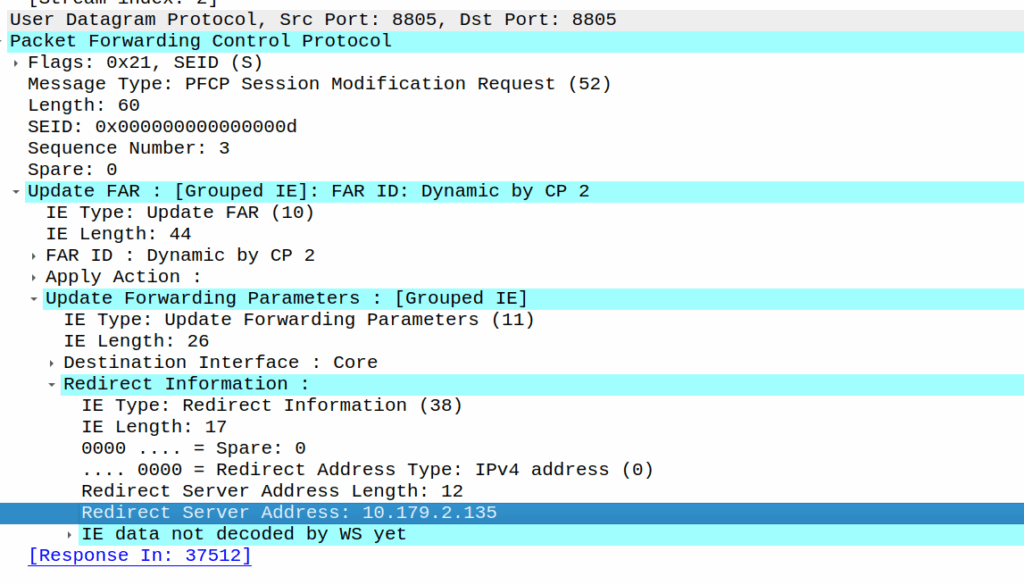
The Redirect Server Address in the Redirect Information IE in PFCP

We do a few things on the UPF at this point, the first, is that we block forwarding access to all IPs except 10.179.2.135 (The redirect server in the screenshot), and we steal / intercept all DNS queries.

This means if you query facebook.com after the Redirect Information is in place, you get back an A-Record answer for facebook.com but it’s telling you Facebook lives on our redirect server.

We’ve got a whitelist on our UPF for certain domains, so if we’re sending you to a self-signup page, you’re going to need to be able to hit our payment processors portals (Stripe, Paypal, etc), so we need to allow their domains, but we don’t know their IPs, so instead we do server side DNS lookups (via our DNS servers before you sneaky kids get any other ideas) for the whitelsited domains, and if it’s on our DNS whitelist, we allow resolution to those domains and allow access to those IPs returned in the DNS response.
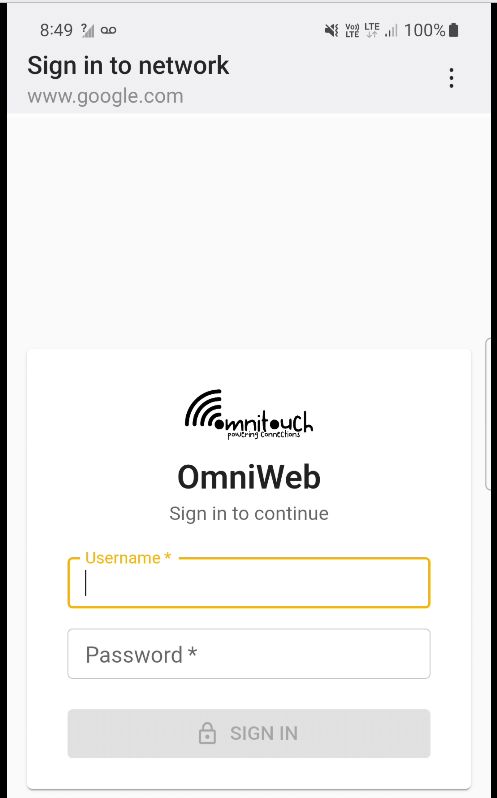
In my lab I’m redirecting HTTP traffic to a management server

Turning it off just involves sending another PFCP Session Modification Request but without the redirect information.
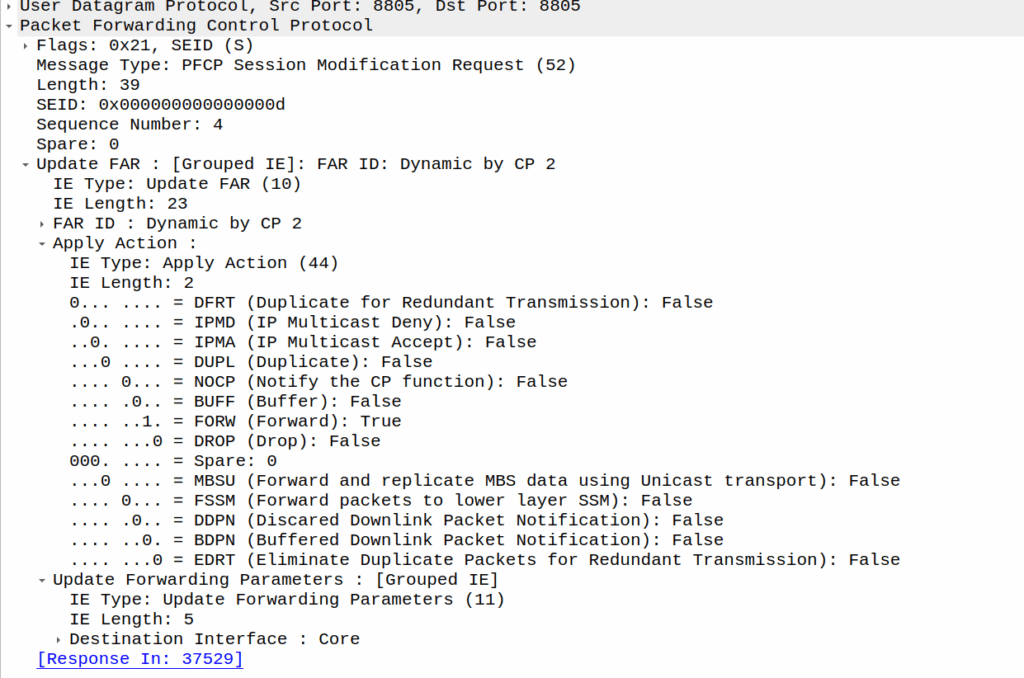
Once this is set we’re back resolving addresses.


The NRF in 5GC – Common Dialogs – Nnrf_NFManagement

The Network Repository Function is essentially a database used to store/query information about NFs on the network.

To do this, the NRF has 3 services: the Nnrf_NFManagement Service is used to insert/update/remove records into the database of NFs on the network, the Nrf_NFDiscovery service is used to query this database, and the OAuth2 Authorization service is used to authenticate / authorize the transactions of the first two securely.

The Nnrf_NFManagement Service

The Nnrf_NFManagement Service is the service that handles the registration, deregistration and updating the database of service-producing NFs.

When a NF offering a service becomes ready for service, it registers with the NRF to advise the NRF of the services it offers and so service-consumers (Clients) are able to find and then request services from this NF.

Let’s take a look at the NFRegister process, which is the service operation used to register an NF in the NRF.

At its heart, the NFRegister process is a HTTP2 PUT sent from the NF to the NRF to the path <nrf_ip>/nnrf-nfm/v1/nf-instances/{nrf-instance-id} with a JSON payload containing all the specifics of the services being offered by the NF (NFProfile), which is sent to the NRF.

The NRF parses through the message body (That JSON Payload containing the NFProfile) and adds all this info to the internal database in the NRF as to which service producers it has available.

If this is all OK from the NRF’s perspective, then a 200 OK is sent back by the NRF.

The NFProfile JSON body

The NFProfile is a JSON encoded message body that contains all the info about the NF that the NRF takes and adds to its internal database of services offered by that NF.

nfInstanceID – The Network Function Instance ID is the unique identity if this NF. (It’s also included in the Request URI) It’s a unique ID and typically generated randomly by the NF itself.

nfType – The type of the NF itself, there’s a long list of supported NF Types, NRF, UDM, AMF, SMF, AUSF, etc, etc.

nfStatus – Is the status of the NF, either REGISTERED (Discoverable by other NFs), SUSPENDED (Registered in the NRF but not able to be discovered / invisible, NFs in this state are usually here because they’ve had a high failure rate or haven’t been responding to heartbeats), UNDISCOVERABLE (Used when an NF wants to stop offering services to new consumers, but is still able to offer services to existing consumers, the idea being this is taking it out of the discovery pool, but still able to serve in-process requests).

plmnList – This is a list of PLMNs that this NF serves.

fqdn – The Fully Qualified Domain name of the NF

IPv4Address / IPv6Address – The IPv4 and/or IPv6 address of the NF

nfService – This is a list of JSON objects, detailing the services offered by the NF, such as the service names it is offering, version of the service, IDs of the service instances and IP Endpoints for requests to be sent to.

priority / capacity / load – Used for selection of this NF from the pool and the order of results returned

The Nnrf_NFManagement Service also includes a Subscription service, to allow NFs to subscribe to changes in state, for example getting a notification if a NF that was registered becomes deregistered.

Uncomfortable Questions to ask about 5G Standalone at MWC – Part 3 – We *have* to do 5GC.

This post follows on from Part 1 and Part 2 of this 3 part series.

We are forced to move to 5G-SA

Claim: We must use 5G-SA with this spectrum (It’s a condition of the license)

I’ll concede that if it is a requirement for a license or funding, that 5G-SA be used, then that’s a pretty ironclad reason to introduce 5G-SA.

Claim: Users will Leave if you don’t have 5G-SA

We could argue the opposite effect will happen; Shifting to SA will reduce your user base.
Here’s why:

Users experiencing 5G-NSA (Non-Standalone) today, are already getting the speed boost from “5G”.

From a user perspective, while 5G-NSA support has been becoming common on mid-to-high priced handsets, handsets supporting 5G-SA are far less common.

Dish’ Project Genesis is one of the only examples of a 5G SA network deployed on a large scale. It launched with only a single supported phone (A Motorola branded handset) and today the supported phone list is very short, limited to expensive flagships. This lack of handset support means users must purchase a handset through Dish rather than being able to bring their own phones, as the only way that compatibility can be guaranteed is by controlling the whole ecosystem.

Unless you are in a highly developed market with 2G and 3G turned off, where the majority of your user base has recent generation flagship phones capable of supporting these features, you’re shrinking your addressable market with 5G-SA, rather than expanding it.

Conclusion – 5G-SA doesn’t stack up, what do I do?

SA doesn’t make sense for a lot of operators and markets – for now. I’m sure this post will look pretty dated in a few years time as many of these factors change and as operators sunset 2G and 3G networks.

I’m not advocating for 5G-SA never, I’m advocating not 5G-SA today.

There are simply better options out there for spending that operations budget to make network improvements.

Off the bat some ideas to expore:

  • Optimize your existing network.
  • Roll out NSA to an even larger area.
  • Shutdown 2G/3G layers.
  • Simplify your operations.
  • Cut down the number of vendors and moving parts.
  • Simplify again.
  • Automate.
  • Simplify more.

Doing this will mean you can enjoy cost savings from reduced headcount thanks to a simpler network.
Simpler networks have better up-time, thanks to operating a network that’s less frankensteiny – less cobbled together from disparate legacy parts.
You’ll also Enjoy reduced opex from all the systems you’ve shut down and cheaper roaming from all the bilaterals you moved to VoLTE.

All of these tasks will keep project teams busy for years and put the MNO in a stronger position moving forward, without getting distracted by slick marketing and shiny brochures.

5Gethernet? – Transporting Non-IP data in 5G

I wrote not too long ago about how LTE access is not liked WiFi, after a lot of confusion amongst new Open5Gs users coming to LTE for the first time and expecting it to act like a Layer 2 network.

But 5G brings a new feature that changes that;

PDU Session Type: The type of PDU Session which can be IPv4, IPv6, IPv4v6, Ethernet or Unstructured

ETSI TS 123 501 – System Architecture for the 5G System

No longer are we limited to just IP transport, meaning at long last I can transport my Token Ring traffic over 5G, or in reality, customers can extend Layer 2 networks (Ethernet) over 3GPP technologies, without resorting to overlay networking, and much more importantly, fixed line networks, typically run at Layer 2, can leverage the 5G core architecture.

How does this work?

With TFTs and the N6 interfaces relying on the 5 value tuple with IPs/Ports/Protocol #s to make decisions, transporting Ethernet or Non-IP Data over 5G networks presents a problem.

But with fixed (aka Wireline) networks being able to leverage the 5G core (“Wireline Convergence”), we need a mechanism to handle Ethernet.

For starters in the PDU Session Establishment Request the UE indicates which PDN types, historically this was IPv4/6, but now if supported by the UE, Ethernet or Unstructured are available as PDU types.

We’ll focus on Ethernet as that’s the most defined so far,

Once an Ethernet PDU session has been setup, the N6 interface looks a bit different, for starters how does it know where, or how, to route unstructured traffic?

As far as 3GPP is concerned, that’s your problem:

Regardless of addressing scheme used from the UPF to the DN, the UPF shall be able to map the address used between the UPF and the DN to the PDU Session.

5.6.10.3 Support of Unstructured PDU Session type

In short, the UPF will need to be able to make the routing decisions to support this, and that’s up to the implementer of the UPF.

In the Ethernet scenario, the UPF would need to learn the MAC addresses behind the UE, handle ARP and use this to determine which traffic to send to which UE, encapsulate it into trusty old GTP, fill in the correct TEID and then send it to the gNodeB serving that user (if they are indeed on a RAN not a fixed network).

So where does this leave QoS? Without IPs to apply with TFTs and Packet Filter Sets to, how is this handled? In short, it’s not – Only the default QoS rule exist for a PDU Session of Type Unstructured. The QoS control for Unstructured PDUs is performed at the PDU Session level, meaning you can set the QFI when the PDU session is set up, but not based on traffic through that bearer.

Does this mean 5G RAN can transport Ethernet?

Well, it remains to be seen.

The specifications don’t cover if this is just for wireline scenarios or if it can be used on RAN.

The 5G PDU Creation signaling has a field to indicate if the traffic is Ethernet, but to work over a RAN we would need UE support as well as support on the Core.

And for E-UTRAN?

For the foreseeable future we’re going to be relying on LTE/E-UTRAN as well as 5G. So if you’re mobile with a non-IP PDU, and you enter an area only served by LTE, what happens?

PDU Session types “Ethernet” and “Unstructured” are transferred to EPC as “non-IP” PDN type (when supported by UE and network).

It is assumed that if a UE supports Ethernet PDU Session type and/or Unstructured PDU Session type in 5GS it will also support non-IP PDN type in EPS.

5.17.2 Interworking with EPC

If you were not aware of support in the EPC for Non-IP PDNs, I don’t blame you – So far support the CIoT EPS optimizations were initially for Non-IP PDN type has been for NB-IoT to supporting Non-IP Data Delivery (NIDD) for lightweight LwM2M traffic.

So why is this? Well, it may have to do with WO 2017/032399 Al which is a patent held by Ericsson, regarding “COMMUNICATION OF NON-IP DATA OVER PACKET DATA NETWORKS” which may be restricting wide scale deployment of this,