I was recently asked by a potential customer if we supported Gx over Gy.
I’d never heard of this before, so I gave my standard “If it’s in the spec we should support it, but I’ll check” answer, and got them to send me a PCAP, which I’ve got.
This is weird.
So for starers, Protocoldex has nothing for this application ID (16777225), even though it has all the LTE diameter specs.
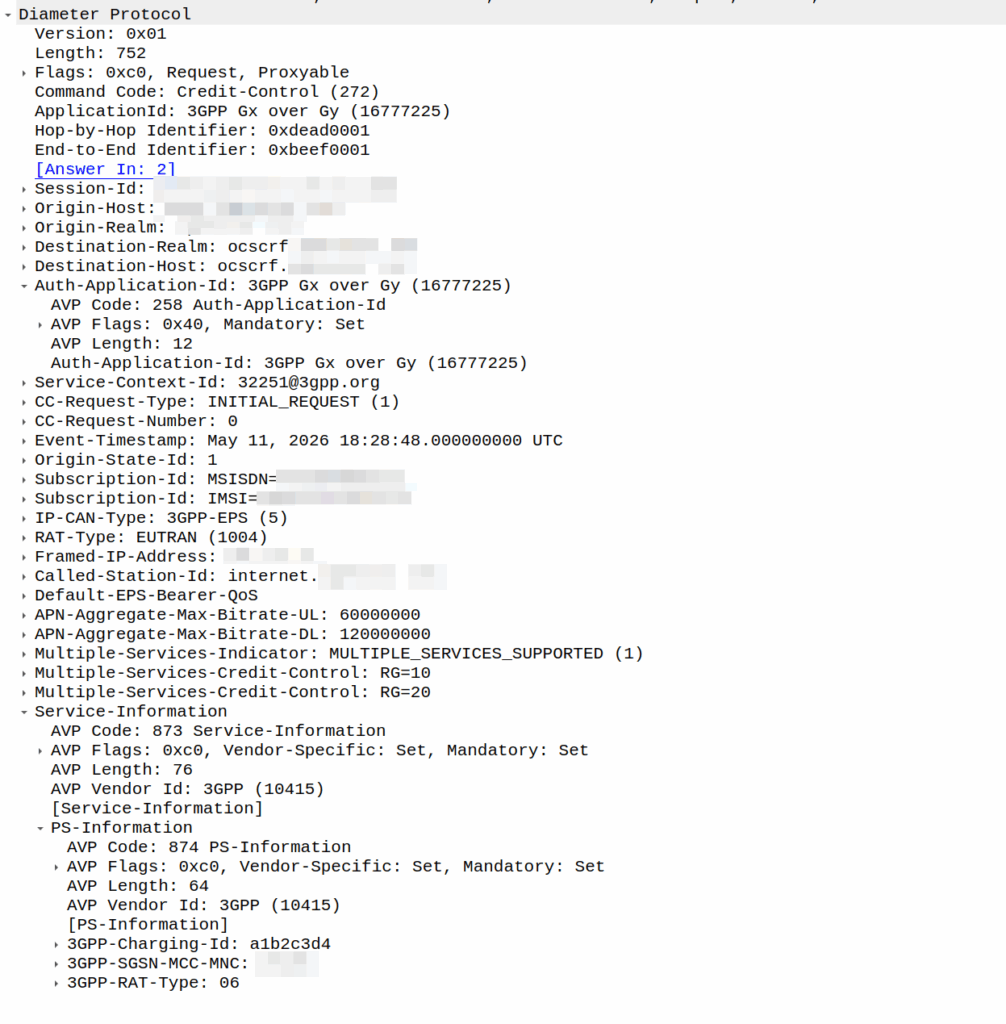
My starting point was TS 29.230 TS Diameter applications; 3GPP specific codes and identifiers which acknowledged the existence of “Gx over Gy” with IANA code 16777225 and pointed me to TS 29.210 which is a 3G spec (which is not a LTE / 4G spec).
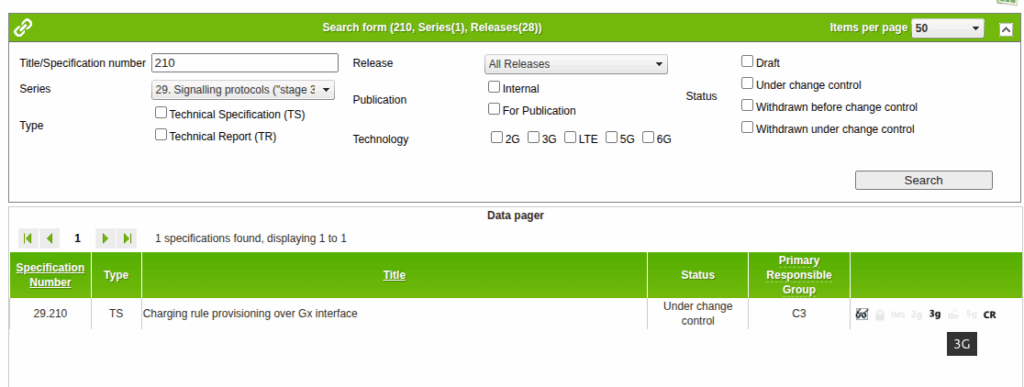
The last version was from 2006, in 3GPP release 6, which is two years before LTE was standardized in Release 8. The word LTE does not appear in the doc or in the metadata tags.
It speaks of TPF (Traffic Plane Function) and TPF (Charging Rules Function).
LTE is “Long Term Evolution” – In later releases this draft TPF would evolve into the PGW (before the PGW-C / PGW-U divorce) and the TPF would go on to become the PCRF (and save spring break).
Reading through these early specs is like looking at Homo Eructs (get your mind out of the gutter) and knowing it evolves into Homo Sapiens.
So what does Gx over Gy do? Well, the concept is pretty straightforward, rather than needing a Sy interface between the PCRF and OCS, you can provision policy rules from the OCS, rather than on the PCRF.
Of course, you could never run VoLTE on this (the P-CSCF needs the Rx interface to the PCRF to provision dedicated bearers and the PCRF provisions those over TFTs over Gx interface).
So what network functions should implement this standard? Well, the P-GW specs do not reference this as something that’s included in the P-GW, nor is it in the GGSN – This was a “gooch” spec between the hypothetical standards land and real world implementations.
So will we be implementing it? Probably not. But an interesting bit of archaeology and a look through the genealogy of 3GPP.
I haven’t understood much, but sounds cursed