These are my lecture notes from IMT’s NET02x (4G Network Essentials) course, I thought I’d post them here as they may be useful to someone. You can find my complete notes here.
Mobile networks are by definition, mobile.
In a fixed network, if I were to connect my laptop to my network at home, I’d get a different address to if I plug it in at work.
In a mobile network UEs are often moving, but we can’t keep changing the IP address – that would lead to all sorts of issues.
The UE must maintain the same IP address, at least for the duration of their session.
Instead the IP address of a UE is allocated by the P-Gateway (P-GW) when the UE attaches.
The IP the P-GW allocates to the UE is in a subnet managed by the P-GW – that IP prefix is associated with the P-GW, so traffic is sent to the P-GW to get to the UE.
Therefore all traffic destined for the UE from external networks will be sent to the P-GW first.
Because the UE is mobile and changing places inside the network, we need a way to keep the UE’s IP even though it’s moving around, something that by default TCP/IP networks don’t cater for very well.
To achieve this we use a technique known as encapsulation where we take the complete IP packet for the UE, and instead of forwarding it on to the UE on a Layer 3 or Layer 2 level, we bundle the whole packet up and put it inside a new IP packet we can forward on anywhere regardless of what’s insude, until it gets to the eNB the UE is on when it can be unpacked and sent to the UE, which is unaware of all the steps / hops it went through.
The concept is very similar to GRE to a VPN (PPTP, IPsec, L2TP, etc) where the user’s IP packets are encapsulated inside another IP packet.
We encapsulate the data using GTP – GPRS Tunneling Protocol.
From a Layer 3 perspective the fact the contents of the GTP packet (another IP packet) is irrelevant, and it’s just handled like any other IP packet being sent from the P-GW to the S-GW.
Getting traffic to the UE
When a packet is sent to the UE’s IP Address from an external destination, it’s first sent to the P-GW, as the P-GW manages that IP prefix.
The P-GW identifies the packet as being destined for a UE, so it encapsulates the entire packet for the UE, by wrapping it up inside a GTP packet.

The P-GW then forwards the GTP packet to the serving Serving-Gateway (S-GW)’s IP Address, so the S-GW can forward it to the eNB to get to the UE.
(The P-GW forwards the traffic to the S-GW so the S-GW can get it to the correct eNB for the UE, the reason for having two nodes to manage this is so it can scale better)
Once the traffic gets to the the eNB serving the UE, the eNB de-encapsulates the data, so it’s now got an IP packet with the destination IP of the UE.
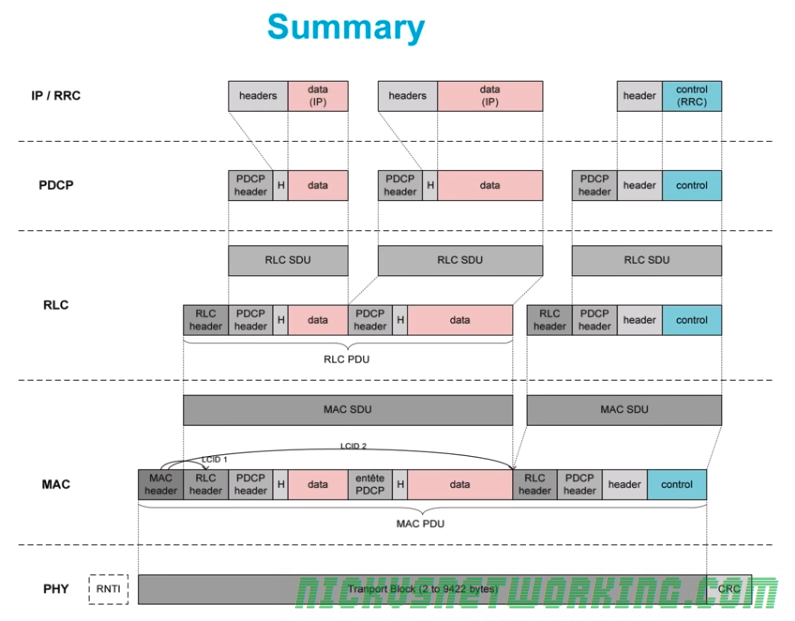
It takes the data and puts it onto a transport block sent to the specific RNTI of the UE.
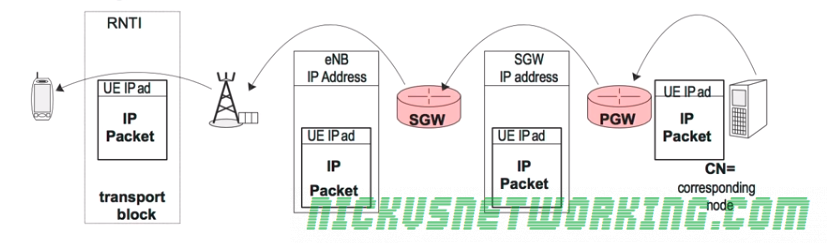
The hops between the UE and the P-GW are transparent to the UE – it doesn’t see the IP Address of the eNB or the S-GW, or any of the routers in between.
Further Reading
Wikipedia – GPRS Tunneling Protocol