This is an idea I’ve been kicking around for a little while – A single GSM TRX being broadcast across multiple cell sites.
Generally in GSM land, a “TRX” is a cell or a sector – but it doesn’t need to be. Later in GSM features like antenna diversity allow the same signal to be broadcast out multiple ports and received on multiple ports, and these to even work together.
Knowing this is possible, what if you run a single TRX across multiple cells / sectors / sites?
This means rather than cell site A & cell site B being “neighbors” they’re a single TRX. A subscriber moving between the two sees the same LAC and Cell ID, but they see the signal strength drop and then rise as they move between the cells, but there’s no “handover” – it’d look to the phone the same as going away from a cell then coming closer, which is what they’ve done, but the cell is being broadcast from two locations.
So why do this? Well, while VoLTE is nice, handset support on low end feature phones is still shite, and it means in some of the places we operate we couldn’t capture the low end of the market – those who just needed a basic voice service.
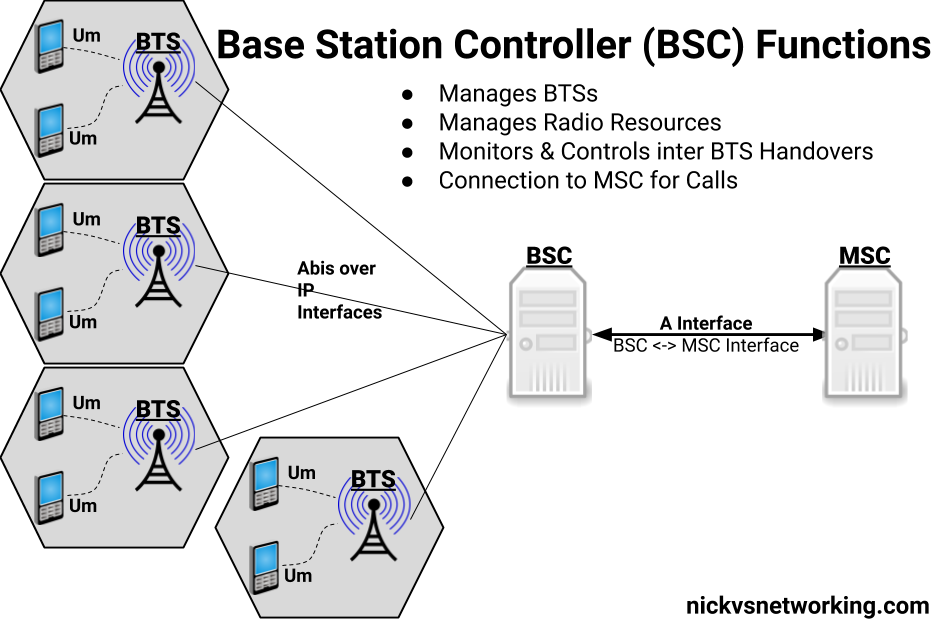
As such we’ve finally added an MSC to our product offering (after almost 10 years of me swearing there’s no way we’d build legacy crap) and a BSC that’s compatible with our existing RAN portfolio (Nokia Airscale), all to be able to address that gap, by running a small GSM layer off our existing radios.
The capacity would be shared of course – this is just one TRX, so 8 full rate channels, but for our use of CSFB for feature phones, garbage IoT devices, it doesn’t matter. On spectral efficiency this is way better than a 5Mhz UMTS carrier (smallest you can do) and co-exists nicely with LTE.
Running a large number of sectors / cells on a common single TRX means when you’ve got a boundary where you need to hand to another TRX, you need fewer channels your reuse pattern. Even running 3 TRXes in our “Super cell” area, is only 600Khz of bandwidth consumed, and if the area is large enough we can do a ~3:1 reuse pattern.
For this to work we’ve got to serve all the cells of a single baseband, but baseband hotels are becoming the norm, and fiber is everywhere. I did start exploring if we could do one TRX on multiple BTSes on our BSC, from an Abis perspective it’d work, but we’d need to ensure timing and I don’t know enough about how the clocking works on our BTSes to say for sure that they’d be in sync even with GLONASS/GPS.
Would this work at scale? I’ve no idea, but I’m hoping to find out!